
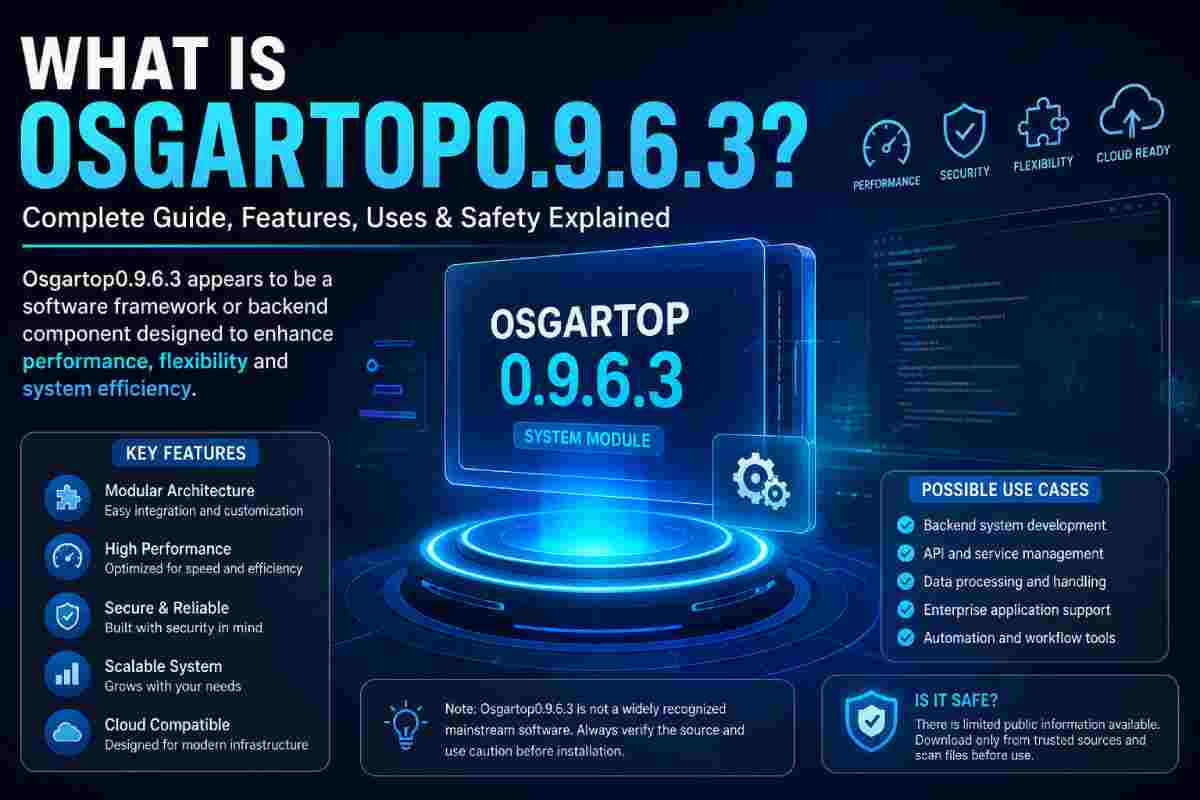
On the surface, osgartop0.9.6.3 seems like a software version, a module name or an internal technical identifier. From the search results which I could find evidence for, the word appears mainly on recent blog-like articles, and not in official documentation, a public repository, or the page of a well known software vendor. Therefore the safest way to interpret it is an obscure software like name which people are describing as some kind of backend or framework tool.
This article belongs to Tech Guides
In essence the ‘0.9.6.3’ part looks like a version number, and version numbers can be used to convey the stage, development level and stability of software, as shown in Semantic Versioning for instance which defines version numbers in a structured way as ‘major’, ‘minor’ and ‘patch’.
For a Chilean audience, this is relevant as many people searching an unknown technical word found it on the name of a downloaded file, in system logs, on a forum or as a header of an article. When a name is so strange like this, it should be read like an unknown clue and nothing more. That is exactly how this article treats it.
Table of Contents
Definition of Osgartop0.9.6.3
Osgartop0.9.6.3 can be understood as a software-style label made of two parts: a project or module name (“osgartop”) and a release version (“0.9.6.3”). From the online articles that I could find, it is explained as a behind the scenes helping thing for performance, flexibility and organizing systems. As those are mainly non-official and informal sources, this description should be considered as an educated guess, rather than an confirmed product fact.
Software starting with a 0.9 typically denotes something still being developed. With software version numbering schemes, numbers usually indicate a part of a project in its lifecycle, and often patch-type numbers indicate minor revisions and bug fixes.
Therefore, and in layman’s terms, osgartop0.9.6.3 may refer to:
A tool or part that is still being developed and may be intended for some technical use and probably for developers or builders rather than end users. The final statement of it being a confirmed official product statement rather than an assumption made from the search results and naming conventions of software.
Why People Search for It
There are a few reasons a term like osgartop0.9.6.3 catches attention. The first, the term itself sounds very technical. And technical words can quickly make someone feel like they’re about to use a software, malware, a plugin or an internally developed build. The second thing is that it appears like a versioned build (version 2.0), which inherently sounds more “real” than a string of arbitrary letters.
Thirdly, given limited and mixed search results people search for more explanations, and want clear and simple ones. For Chileans, there’s an additional reason: many English technical terms appear within Spanish language workflows (in development, IT support, digital marketing…). In such a case the label becomes much more important than the actual provenance. People ask: what is it? Is it safe? Is it useful? Should I install it? The articles I found are written around those same questions.
Comparison Table: Osgartop0.9.6.3 vs Typical Software Patterns
| Feature | Osgartop0.9.6.3 | Typical Stable Software | Manual / Traditional Workflow |
|---|---|---|---|
| Main purpose | Described online as a backend or framework-style tool | Designed to solve a specific user or business problem | Relies on people, documents, and repeated manual steps |
| Version stage | Looks like a pre-1.0 release | Usually 1.0 or later, more mature | No versioning at all |
| Target users | Likely developers or technical teams | End users, businesses, or developers | Office staff, teams, or individuals |
| Flexibility | Said to be modular and configurable | Often balanced between features and stability | Flexible in a human way, but slower |
| Stability | Likely under active improvement | Generally more polished and tested | Depends on people and process discipline |
| Risk level | Hard to verify because the term is obscure | Usually documented and easier to evaluate | Low technical risk, but high human error risk |
| Documentation | Not clearly verified from official sources | Usually has official docs, release notes, and support | Documented through SOPs, emails, or spreadsheets |
This table is a comparison of patterns, not a claim that osgartop0.9.6.3 has all of these properties in an officially confirmed way. The reason for using this format is simple: the public information around the term is limited and mostly blog-based.
Possible Features People Associate With It
When writers online describe osgartop0.9.6.3, they often connect it with features that are common in modern backend tools. Such features, in rough order: modularity, lightness, behavior driven by configuration, and system optimization. Yet again, these are informal article descriptions and read as possibilities rather than definite product capabilities.
Here is a simple way to think about those features:
- A modular structure means the system may be divided into smaller parts.
- A lightweight design may help avoid unnecessary resource use.
- A configurable setup means settings may control how it behaves.
- Performance focus means the goal may be speed, efficiency, or smoother processing.
- Cloud friendliness means it may be described as suitable for modern infrastructure.
For a non-technical reader, the easiest takeaway is this: if osgartop0.9.6.3 is being used correctly in those articles, it is being framed as a support tool, not a front-facing app people open every day. It is the kind of thing that works in the background.
What Makes It Interesting
The interesting part is not only the name itself, but the way it is presented online. A rare term with a version number tends to trigger curiosity because it sounds like it belongs to a serious technical system. That effect is common in software naming, especially when release numbers suggest ongoing development. Semantic versioning exists precisely because version numbers can communicate meaning about change and stability.
From a reader’s point of view, osgartop0.9.6.3 becomes interesting for three reasons:
- It looks technical even before you know what it does,
- It suggests there is a deeper system behind the label,
- It raises questions about safety, reliability, and purpose.
That is why search traffic around strange software names can grow quickly. People are not only searching for information; they are also trying to decide whether the term is legitimate, experimental, or simply misunderstood.
Is Osgartop0.9.6.3 Safe?
That is the question that many of the readers will ask first and the question that most certainly deserves a proper answer. However, from what I was able to gather I was unable to find sufficient authoritative documentation on what exactly osgartop0.9.6.3 is technically speaking. Without that, a judgment cannot be made in full confidence based on name.
A cautious reader should treat any unfamiliar software label this way:
- Check whether there is an official website or repository,
- Look for clear documentation,
- Verify who published it,
- Avoid installing anything from an unknown source,
- Scan files before running them.
Those are general software-safety habits, and they matter even more when the name is obscure. Software, after all, is simply the set of instructions or programs that tell a computer what to do, so trust and source matter a great deal.
For additional guidance on software provenance and evaluating software supply chains, readers can also consult CISA’s software supply chain guidance.
Why Version Numbers Matter
The “0.9.6.3” style is not just decoration. Version numbers help people understand whether software is new, stable, experimental, or recently changed. Semantic Versioning describes how release numbers communicate change across major, minor, and patch levels.
In simple terms:
- A major change may signal a big shift,
- A minor change may add features,
- Apatch may fix bugs,
- A number that begins with 0 often suggests early-stage work.
So if osgartop0.9.6.3 is being used as a release label, it likely implies a project that is still evolving rather than one that is fully finalized. That is an inference based on standard versioning practice, not a confirmed statement about an official product.
Final Thoughts
The best, most natural way to refer to osgartop0.9.6.3 is like this: It seems to be a little known software-like term that people writing on the internet are conceptualizing as if it’s a framework/backend type of thing with a version number attached. I could only check blog type entries but no official documentation, so don’t over-read in to this.
For the Chilean reader the bottom line is practical: Don’t be so hasty in installing, spreading or believing something with a tech name you don’t understand. Check who wrote it, who is publishing it and get some official proof for whatever you encounter online. It matters more than the name.
For readers looking for related technology topics, BeTechIT.com Tech News provides another technology-focused resource, while iPhone 14 Pro Max Price covers specifications and pricing information for a well-known smartphone.
You can also explore How to Find FOK959S-M Model for another example of identifying and understanding an unfamiliar technical model number.