
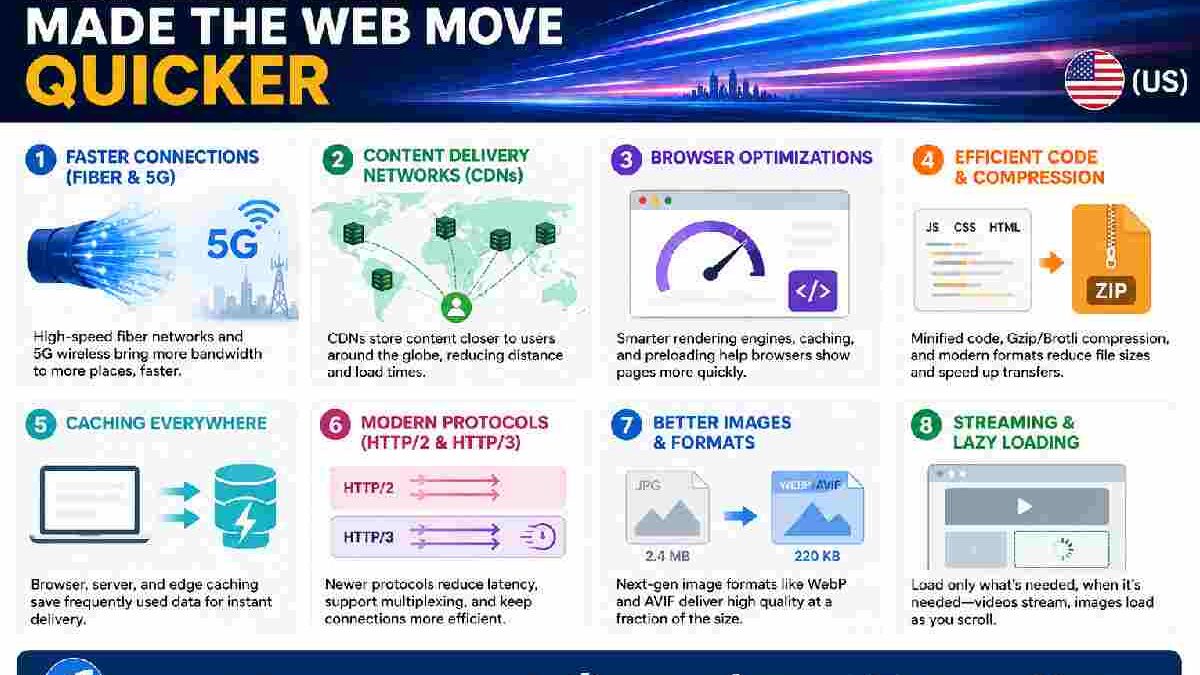
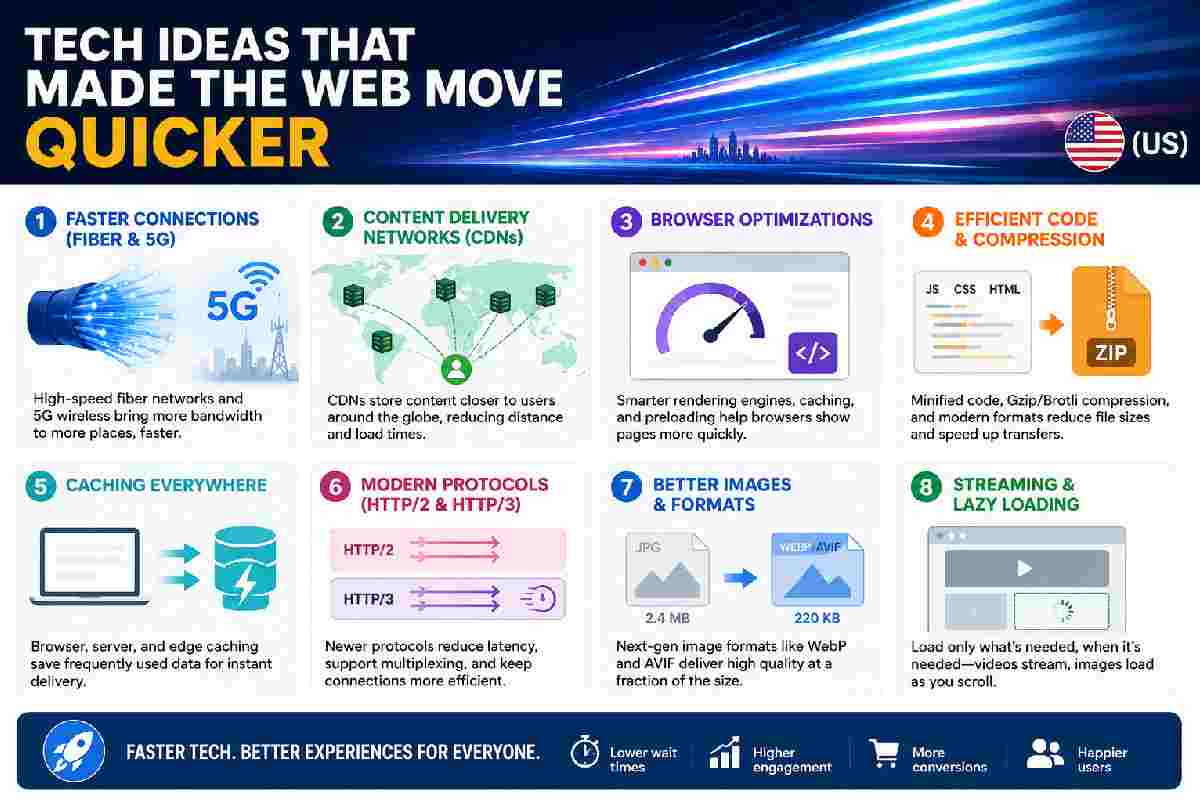
Tech Ideas That Made the Web Move Quicker – Ever wondered why a page that once felt like it would load forever now appears in the blink of an eye? How browsing, streaming, and shopping feel so seamless right now?
This article belongs to Tech Guides
The internet didn’t spontaneously become faster- it evolved, and behind every fast page and slick experience is a chain of ingenious technology concepts; most of which were invented, scaled, or further innovated in the USA.
In this analysis, I’ll outline the 5 most critical innovations that have lead to a faster, smarter and more responsive web experience. No jargon in this piece, just explanations explained by a real human.
Table of Contents
So what is a ‘faster web’?
A faster web means:
- Pages load quickly (low latency)
- Content appears without delays
- Interactions feel instant (no lag)
- Media streams smoothly
It’s not just about speed—it’s about experience.
The Early Problem: Why the Web Was Slow
Back in the 1990s and early 2000s, the web had some serious limitations:
- Dial-up connections were painfully slow
- Servers were centralized and overloaded
- Images and scripts were heavy
- No smart caching or optimization
Result?
You clicked… and waited.
The Breakthrough Ideas That Changed Everything
So let’s go over some key innovations that have impacted on web performance.
CDNs
What is a CDN?
A Content Delivery Network is a set of distributed servers used to serve content based on location.
Rather than being delivered by one central server in one particular country, CDNs allow content to be delivered much nearer to the end-user.
Why It Matters
- Reduces load time
- Minimizes latency
- Handles high traffic efficiently
Example in Real Life
By default, when you open up a website, rather than having the data transferred from the USA, it will be transferred from a closer server from India.
CDN Benefits Table
| Feature | Without CDN | With CDN |
|---|---|---|
| Load Time | Slow | Fast |
| Server Load | High | Distributed |
| User Experience | Inconsistent | Smooth |
| Global Reach | Limited | Worldwide |
Browser Caching
What is Caching?
Caching stores parts of a website (like images or scripts) in your browser so they don’t need to reload every time.
Why It Changed the Game
- Repeat visits become faster
- Less data usage
- Reduced server requests
Simple Explanation
Think of it like saving a copy of a page locally—next time, it opens instantly.
JavaScript Optimization & Async Loading
The Problem Before
JavaScript used to block page loading. Nothing would show until scripts finished loading.
The Innovation
- Async and defer loading
- Faster execution engines
- Smarter frameworks
Impact
- Pages load progressively
- Users see content faster
- Interactions feel smoother
Image Compression & Modern Formats
Images used to be the biggest reason for slow websites.
Key Innovations
- JPEG optimization
- PNG compression
- Modern formats like WebP and AVIF
Why It Matters
Images now load faster without losing quality.
Image Optimization Table
| Format | File Size | Quality | Speed Impact |
|---|---|---|---|
| JPEG | Medium | Good | Moderate |
| PNG | Large | High | Slow |
| WebP | Small | High | Fast |
| AVIF | Very Small | Excellent | Very Fast |
HTTP/2 and HTTP/3 Protocols
What Are These?
These are upgraded versions of the HTTP protocol that governs how data travels on the web.
Key Improvements
- Multiple requests at once
- Faster data transfer
- Reduced latency
Why It’s Huge
Instead of loading files one by one, browsers can now load many simultaneously.
Cloud Computing Infrastructure
What Changed?
Web hosting moved from physical servers to scalable cloud platforms.
Benefits
- Auto-scaling during traffic spikes
- Faster global access
- Better uptime
Real Impact
Your favorite sites don’t crash during heavy traffic anymore.
Lazy Loading
What is Lazy Loading?
Content loads only when needed.
For example:
- Images load when you scroll down
- Videos load only when clicked
Why It Works
- Saves bandwidth
- Speeds up initial page load
Minification of Code
What Does It Mean?
Removing unnecessary characters from code:
- Spaces
- Comments
- Line breaks
Result
Smaller files = faster loading.
Edge Computing
What is Edge Computing?
Processing data closer to the user instead of a central server.
Why It’s Powerful
- Reduces delay
- Improves real-time performance
Use Cases
- Streaming
- Gaming
- Real-time analytics
Progressive Web Apps (PWAs)
What Are PWAs?
Web apps that behave like mobile apps.
Features
- Offline access
- Fast loading
- App-like experience
Why They Matter
They reduce dependency on heavy apps and improve speed.
Database Optimization
The Hidden Hero
Faster databases = faster websites.
Techniques
- Indexing
- Query optimization
- Caching layers
Result
Data loads instantly instead of lagging.
AI-Based Performance Optimization
The New Era
AI now helps:
- Predict user behavior
- Preload content
- Optimize delivery
Example
If you often visit a page, AI may preload it before you click.
Comparison Table: Old Web vs Modern Web
| Aspect | Old Web | Modern Web |
|---|---|---|
| Speed | Slow | Fast |
| Load Time | 5–30 seconds | < 3 seconds |
| Media Handling | Limited | Advanced |
| Scalability | Poor | Excellent |
| User Experience | Frustrating | Smooth |
How do these innovations work together?
Here’s the real magic:
- CDN delivers content faster
- Caching avoids repeat loads
- Compression reduces size
- Protocols speed up transfer
- Cloud scales everything
Together, they create a seamless experience.
For readers interested in broader technology topics, Technology provides additional technology-related information.
Real-Life Example: Loading a Website Today
When you open a modern website:
- CDN serves content from nearest server
- Browser loads cached elements
- Images load progressively
- Scripts run asynchronously
- Data fetched via optimized APIs
All of this happens in seconds—or less.
Why the US Played a Big Role
The United States has been central to many of these innovations because:
- Major tech companies are based there
- Strong infrastructure investments
- Early adoption of internet technologies
- Continuous research and development
The same broader technology ecosystem also includes devices and hardware such as DJI Mini 2 Features, showing how advances in technology extend beyond web infrastructure.
The Human Side of Faster Web
Let’s be honest—this isn’t just about tech.
A faster web means:
- Less frustration
- More productivity
- Better accessibility
- Improved global communication
It changed how we live, work, and connect.
Challenges That Still Exist
Even with all these advancements, some issues remain:
- Slow rural connectivity
- Heavy websites with poor optimization
- Overuse of scripts and trackers
Speed still depends on how responsibly developers build websites.
For readers exploring different technology platforms and resources, Selmantech.com offers another technology-related topic to explore.
What the Future Looks Like
The next wave of speed improvements may include:
- 5G and beyond
- AI-driven optimization
- Serverless architecture
- Real-time rendering
The goal?
Instant web experiences.
Quick Summary Table
| Innovation | Core Benefit |
|---|---|
| CDN | Faster global delivery |
| Caching | Instant reloads |
| HTTP/2 & HTTP/3 | Faster communication |
| Image Compression | Reduced load size |
| Cloud Computing | Scalability |
| Lazy Loading | Efficient loading |
| Edge Computing | Low latency |
| PWAs | App-like speed |
For related technology and device topics, you can also explore Diesel LEDs and iPhone 13 Pro Max Case.
For additional guidance on web performance, including CDN usage, HTTP/2, compression, image optimization, and lazy loading, readers can refer to MDN Web Performance Best Practices.
Readers interested in device connectivity can also explore How to Pair Kimfly for another technology-related guide.
Final Thoughts
If you reflect on this a moment, the web was not “engineered to get faster”, but “engineerable to get faster.” Each of these concepts, CDNs, caching, smarter protocols, each solved a problem and they combine to revolutionize the way we use a system that would otherwise be extremely slow.
When a page loads instantly next time, realize that there is an entire ecosystem of smart technology working hard in the background